WHAT IS A SPIRAL WOUND GASKET?
A Spiral Wound Gasket (SWG) is one of the most widely used semi-metallic sealing solutions in industrial applications. It is engineered by winding a metallic strip together with a soft filler material to create a resilient and highly effective sealing element.
Spiral wound gaskets are designed to maintain sealing integrity under high temperature, high pressure, thermal cycling, vibration, and flange movement. When correctly selected and installed, they deliver long service life and minimize leakage in critical process systems.
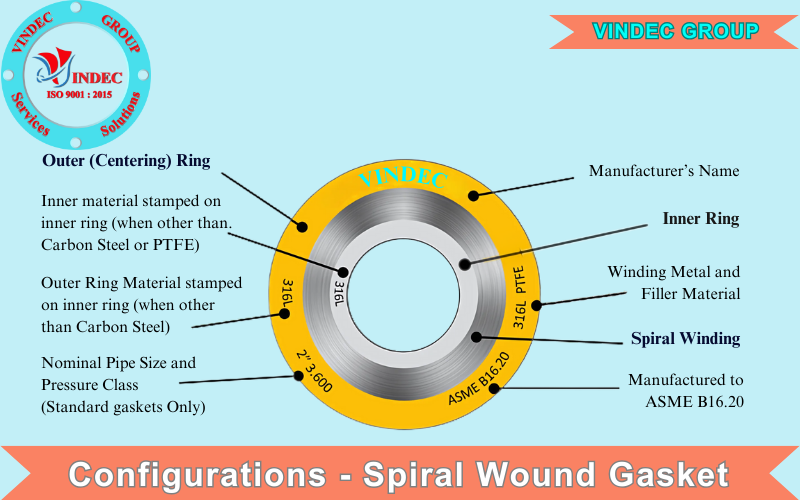
STRUCTURE OF SPIRAL WOUND GASKET
A Spiral Wound Gasket generally consists of three main components:
1. Outer Ring (Centering Ring)
The outer ring is commonly manufactured from carbon steel or stainless steel.
Functions:
-
Centers the gasket during installation
-
Controls gasket compression
-
Protects the sealing element from excessive loading
-
Improves sealing stability
2. Inner Ring
The inner ring is typically manufactured from stainless steel.
Functions:
-
Prevents inward buckling of the sealing element
-
Protects against flow turbulence
-
Minimizes flange erosion
-
Reduces contamination entering the process stream
-
Enhances gasket rigidity and operational safety
Inner rings are highly recommended in high-temperature and high-pressure applications.
3. Sealing Element
The sealing element consists of:
-
Metallic winding strip
-
Soft filler material
Common winding materials:
-
Stainless Steel 304
-
Stainless Steel 316
-
Stainless Steel 321
-
Stainless Steel 347
-
Monel
-
Inconel
-
Titanium
-
Hastelloy
Common filler materials:
Flexible graphite is widely selected for refinery and high-temperature services due to its superior thermal stability.
INSTALLATION GUIDE FOR METALLIC GASKETS
Proper installation is essential to achieve optimum gasket performance.
Installation recommendations:
-
Clean flange surfaces before assembly
-
Verify gasket dimensions and compatibility
-
Position the gasket accurately between flange faces
-
Tighten bolts using a controlled cross-pattern sequence
-
Apply uniform bolt load to avoid uneven compression
-
Re-torque when required by operating procedures
Proper installation helps ensure:
-
Initial sealing performance
-
Long-term sealing reliability
-
Easy maintenance and replacement
TYPES OF SPIRAL WOUND GASKETS
Spiral Wound Gasket Without Rings (Basic Type)
Construction:
Features:
-
Flexible sealing performance
-
Suitable for tongue and groove flanges
-
Suitable for male and female flanges
Applications:
Spiral Wound Gasket With Outer Ring (CG Type)
Construction:
Features:
Applications:
-
Raised face flanges
-
Flat face flanges
Spiral Wound Gasket With Inner Ring (CGI Type)
Construction:
Features:
-
Prevents internal buckling
-
Reduces process turbulence
-
Protects process equipment
Applications:
Spiral Wound Gasket With Inner & Outer Ring
Construction:
Features:
-
Maximum sealing efficiency
-
Excellent structural stability
-
Enhanced pressure resistance
Applications:
MATERIAL IDENTIFICATION – SPIRAL WOUND GASKET COLOR CODES
Outer Ring Color → Metallic Material
-
Yellow → SS304
-
Green → SS316
-
Turquoise → SS321
-
Blue → SS347
-
Orange → Monel
-
Black → Alloy 20
-
Silver → Carbon Steel
-
Brown → Hastelloy B
-
Beige → Hastelloy C
-
Gold → Inconel
-
Red → Nickel
-
Purple → Titanium
Stripe Color → Filler Material
-
Gray → Graphite
-
White → PTFE
-
Pink → Mica
-
Light Green → Ceramic
HOW TO CHOOSE A SPIRAL WOUND GASKET
Selection factors:
THICKNESS OF SPIRAL WOUND GASKET
Typical thickness ranges:
KEY FEATURES OF SPIRAL WOUND GASKET
-
Excellent sealing performance
-
Suitable for high temperature and pressure
-
Superior compression recovery
-
Resistant to vibration and thermal cycling
-
Compatible with aggressive process media
-
Excellent mechanical strength
-
Long operational lifespan
-
Suitable for vacuum and high-pressure systems
Typical operating range:
APPLICATIONS OF SPIRAL WOUND GASKET


